

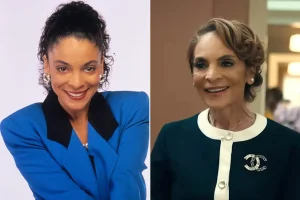
 For nearly four decades, many of us carried the image of Whitley Gilbert in our heads exactly as she was when A Different World first captured our attention: young, stylish, dramatic, unforgettable.
Then Jasmine Guy returned to Hillman.
She had aged.
Of course she had.
So have we.
But almost immediately, some corners of the internet began treating the evidence of those years as though something had gone wrong. Comments picked apart her face, compared the 64-year-old woman standing before us to the twenty-something actress audiences first met in 1987, and turned what should have been a celebration of longevity into another public examination of a woman’s appearance.
And perhaps that is the conversation worth having.
When did getting older become something a woman has to apologize for?
We call growing older a blessing. We celebrate birthdays. We pray for long life. We mourn people who did not get enough years. Yet when a woman actually receives those years, we scrutinize the evidence. The lines. The changing face. The body that no longer looks 25. The very things that prove she lived long enough to change.
That contradiction becomes even sharper for women in entertainment. Age naturally, and people may say you have ‘let yourself go.’ Use cosmetic procedures, and another group accuses you of trying too hard to look young. Somehow, women are expected to age, but without ever appearing to age.
Guy’s response cut directly through that contradiction: growing older brings changes, but beauty, style and joy do not have an expiration date.
And maybe the question is not whether Jasmine Guy has aged ‘well.’
Maybe the better question is:
Have we learned how to let women age at all?
Jasmine Guy’s Return Should Have Been a Celebration
Jasmine Guy, now 64, returned as Whitley Gilbert-Wayne in Netflix’s new A Different World series, which premiered September 24, 2026. The moment connected several generations: longtime viewers who first met Whitley in 1987, younger audiences discovering Hillman College for the first time, and fans eager to see Whitley and Dwayne Wayne together again nearly four decades later.
That return matters.
A Different World helped place Black college life, HBCU culture, friendship, ambition, romance, debate, and community at the center of mainstream television. It gave viewers characters who were funny, complicated, fashionable, intelligent, flawed, and fully human.
The Netflix continuation is not a time capsule. It is a new chapter. Whitley is not supposed to look exactly as she did when she was first introduced. She has lived. She has grown. She has experienced seasons that the audience did not witness.
That is the point of legacy.
At GospelRhythms, we believe entertainment can open meaningful conversations about culture, faith, identity, and the way we value one another. Explore more stories through our GospelRhythms faith coverage and GospelRhythms media platform.
The Impossible Standard Placed on Black Women
Black women’s appearances have long been treated as public property.
People comment on our hair, skin, bodies, faces, weight, clothing, makeup, and presentation as if every part of us exists for public approval. Natural hair can be criticized. Protective styles can be criticized. Gray hair can be criticized. Aging naturally can be criticized. Choosing cosmetic work can be criticized.
There is often no winning.
Black women are expected to be polished but not “trying too hard.” Beautiful but not intimidating. Stylish but not vain. Strong but not difficult. Youthful but not desperate to look young.
The pressure can be especially intense for Black women in entertainment, whose faces are revisited through old television episodes, award-show appearances, magazine covers, and nostalgic clips. Audiences can freeze a woman in the version of her they first loved, then act surprised when time continues moving.
But nostalgia is not a contract.
Jasmine Guy does not owe the public a permanent return to the face she had in her twenties. She owes no one an illusion that the years have not passed.

When “Black Don’t Crack” Becomes Another Burden
“Black don’t crack” is often offered as praise. It celebrates the beauty and resilience many Black people carry as they age.
But even compliments can become burdens when they turn into expectations.
The phrase can suggest that Black women are supposed to remain nearly untouched by time. It can make visible aging feel like a failure. It can imply that looking youthful is something a woman owes to the culture, to fans, or to strangers online.
Black women deserve better than being celebrated only when their age is difficult to detect.
We should be allowed to age with laugh lines, changing bodies, silver hair, shifting style, health challenges, joy, grief, confidence, uncertainty, and peace. We should be allowed to look like people who have lived.
Aging “well” should not mean meeting somebody else’s beauty standard. Sometimes aging well means surviving. Sometimes it means healing. Sometimes it means laughing more freely, setting better boundaries, loving your family, beginning again, or simply waking up grateful.
The Double Standard Is Real
Men are often allowed to age into distinction.
Their gray hair is called distinguished. Their wrinkles suggest wisdom. Their older bodies are described as seasoned, rugged, or attractive in a new way. A man can return to a beloved role decades later and be praised for his experience.
Women are more likely to be told they have let themselves go, look tired, look different, or have had too much work done. If they age naturally, they may be criticized. If they pursue cosmetic procedures, they may be criticized for that too.
That is not merely an opinion about appearance. It is a double standard.
Naming it is not anti-men. It is pro-truth. Men deserve room to age, and women do too. Nobody should have to earn dignity by looking young.
The Privilege of Still Being Here
What did the criticism miss?
It missed the years Jasmine Guy has lived.
It missed the career she built, the characters she brought to life, the friendships she has carried, the losses she has survived, the lessons she has learned, and the joy she still has the right to experience.
It missed the privilege of seeing a beloved performer return to a role that helped define a generation.
A woman who has lived 64 years has not failed because she no longer looks 24. She has accomplished something precious: she is still here.
That should lead us toward gratitude, not critique.

What Scripture Teaches Us About Age and Legacy
Scripture does not treat age as an embarrassment.
Proverbs 16:31 says, “Gray hair is a crown of splendor; it is attained in the way of righteousness.” Psalm 145:4 reminds us that “one generation commends your works to another; they tell of your mighty acts.”
Deuteronomy 32:7 tells us to remember the days of old and consider the years of past generations. That is a call to honor history, wisdom, and the people who came before us.
And 1 Samuel 16:7 gives us a needed correction: “People look at the outward appearance, but the LORD looks at the heart.”
The internet looks at an image for a few seconds. God sees the whole person.
God sees the story behind the smile, the endurance behind the confidence, the grief behind the wisdom, and the grace that brought someone through another year. Our value is not determined by a comment section, a trending topic, or a comparison to a younger version of ourselves.
Let Women Grow Older in Peace
Jasmine Guy’s message was not a demand that everyone stop discussing beauty. It was an invitation to stop reducing women to beauty.
She encouraged people to spend less time judging appearances and more time loving one another, making memories, and living the lives we are here to live. That is a message worth carrying beyond this particular conversation.
The next time a woman returns to the public eye after many years, let us notice more than her face.
Notice her talent.
Notice her courage.
Notice her contribution.
Notice what she has made possible for the people coming behind her.
And if she looks different, remember: so do you.
That is not an offense. That is evidence of grace.

A Final Word From GospelRhythms
Jasmine Guy’s return as Whitley Gilbert-Wayne is a cultural moment, but it is also a mirror. It asks whether we truly believe women deserve the same freedom to age, change, and remain joyful that we claim to value for everyone else.
Let’s choose honor over inspection.
Let’s choose gratitude over comparison.
Let’s celebrate women not because they have escaped time, but because they have lived through it.
Next stop on the ecosystem → Explore GospelRhythms’ faith and culture coverage.
Related Articles and Resources
- GospelRhythms Faith
- GospelRhythms Media
- GospelRhythms Blog
- Suggested YouTube video: Jasmine Guy discusses returning to Hillman and responding to age-focused criticism
Newsletter CTA
Want more conversations about faith, culture, entertainment, and the people shaping our communities? Subscribe to the GospelRhythms newsletter for encouraging stories and timely features delivered to your inbox.
Prayer
God, thank You for the gift of life and for every year that shapes us into who You created us to be. Help us honor women in every season, resist shallow judgment, and recognize the beauty of wisdom, endurance, and legacy. Teach us to see people beyond appearances and to celebrate the grace carried in every age. Amen.
Reflection Question
What would change in our communities if we treated aging as a testimony instead of a flaw?
Shareable Quote
“Women should not have to prove they have aged well. Let them age, live, laugh, change, and remain fully themselves.”
Social Captions
Instagram:
Jasmine Guy returned as Whitley Gilbert-Wayne nearly four decades after A Different World introduced her to the world. Instead of celebrating her legacy, parts of the internet focused on how she looks at 64. But aging is not a failure. It is evidence of life, survival, wisdom, and grace. Beauty, style, and joy do not expire. Read the full GospelRhythms feature.
#JasmineGuy #ADifferentWorld #Ageism #BlackWomenAndAging #GospelRhythms
Facebook:
Jasmine Guy’s return to Hillman should have been a celebration of culture, legacy, and longevity. Her experience also opened a necessary conversation about why women, especially Black women, are expected to age without ever looking like they have aged. Read why every year lived deserves honor, not critique.
X:
Jasmine Guy is 64. She has lived, worked, created, survived, and returned to Hillman. That is not something to criticize. It is something to celebrate. Beauty, style, and joy do not expire. #JasmineGuy #Ageism #ADifferentWorld
Pinterest:
Jasmine Guy’s return to A Different World sparked a powerful conversation about ageism, Black women, beauty standards, and the right to grow older with dignity, joy, and confidence.
Image Suggestions and Featured Image Prompt
Suggested image approach:
Use bright, candid editorial photography featuring Black women across generations. Prioritize natural age, stylish self-possession, laughter, community, and legacy. Avoid celebrity likenesses, dark lighting, sadness, religious stock imagery, text, logos, coffee, and praying hands.
Featured image prompt:
“Bright, light, realistic contemporary editorial documentary photograph of a confident beautifully styled Black woman in her early 60s laughing naturally in warm daylight on a sunlit city street. Elegant modern tailored clothing with a subtle early-2000s vintage influence, silver-streaked natural hair, visible age lines presented with dignity, self-possession and joy. Candid 35mm photography feel, warm skin tones, high-key natural lighting, multicultural urban background softly out of focus, premium culture magazine aesthetic, clear negative space for a website headline, no celebrity likeness, no text, no logos, no coffee, no religious symbols, no sadness, no dark shadows.”
Sources
- People.com: Jasmine Guy Responds to Commentary About Her Aging
- TheGrio: Jasmine Guy and the Burden of “Black Don’t Crack”
- Complex: Jasmine Guy Calls Out “Brutal” Scrutiny of Women as A Different World Returns
- Way Up With Angela Yee: Jasmine Guy Discusses Her Return to Hillman
🌐 Explore the GospelRhythms Ecosystem
- GospelRhythms: Your home for faith, culture, and Christian entertainment.
- GospelRhythms Magazine: In-depth interviews, reviews, and features on Christian artists and entertainment.
- GOT One TV: Watch exclusive celebrity interviews, music showcases, and reality segments.
- Soul & Self-Care Sunday: Faith-filled resources for your spiritual and emotional wellness.
- Ephraim Entertainment: Kingdom-minded entertainment and media production.


0 Comments